
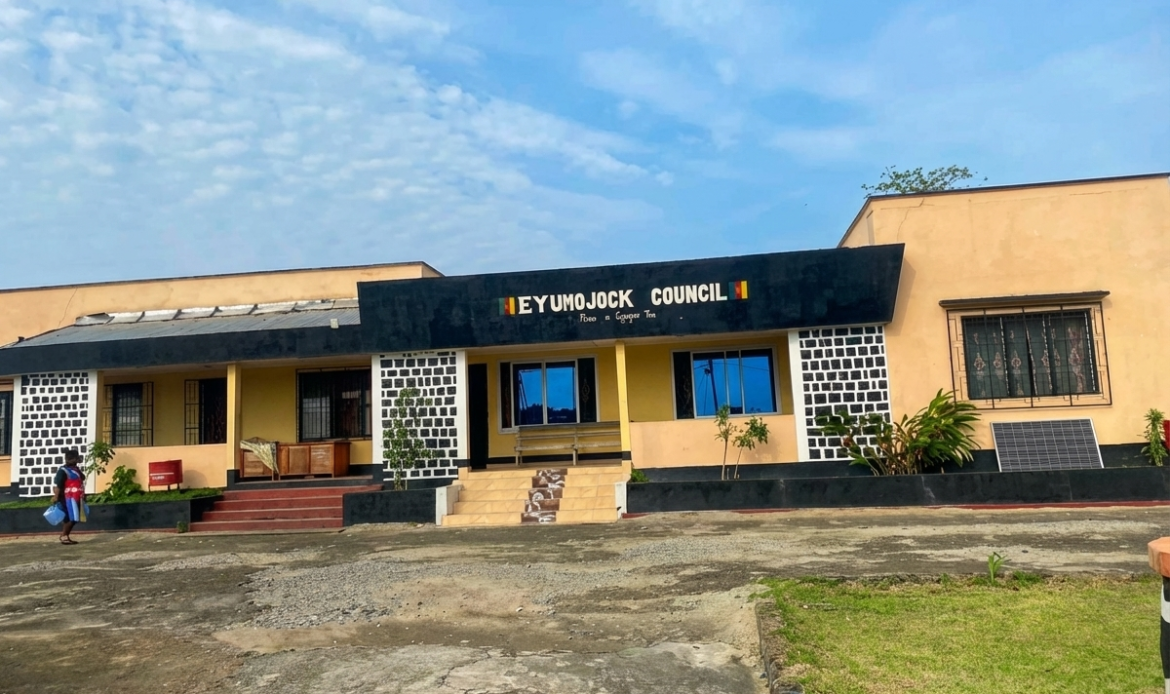

Eyumojock est une commune située dans la région du Sud-Ouest du Cameroun, près de la frontière avec le Nigeria. Connue pour sa diversité ethnique et culturelle, elle abrite principalement les peuples Ejagham et Bayang. Eyumojock est entourée d’une végétation dense et luxuriante, marquée par des forêts tropicales et des paysages vallonnés, ce qui en fait une zone riche en biodiversité.
L’économie de la commune repose essentiellement sur l’agriculture, avec des cultures de cacao, de café et de produits vivriers tels que le manioc et le plantain. L’exploitation forestière, bien que régulée, joue également un rôle important dans l’économie locale. La proximité d’Eyumojock avec le Nigeria favorise le commerce transfrontalier, offrant aux habitants des opportunités économiques supplémentaires.
En dépit de son potentiel, Eyumojock fait face à des défis en matière d’infrastructures, notamment en ce qui concerne les routes et l’accès aux services de base comme l’éducation et la santé. Néanmoins, des projets de développement sont en cours pour améliorer ces aspects, tout en préservant l’environnement naturel. Eyumojock se positionne comme une commune en pleine croissance, avec un fort potentiel de développement agricole et commercial dans le Sud-Ouest du Cameroun.
The Eyumojock council is found in Manyu Division of the South West Region of Cameroon situated some 45km from Mamfe the capital of Manyu Division. The municipality is situated roughly between the towns of Ikom in Nigeria and Mamfe in Cameroon figuring as one of the border councils in the Republic. It shares its western boundary with the Federal Republic of Nigeria, Akwaya lies in the north, Upper Bayang and Mamfe Central occupies the eastern boundary while the south is shared with the Mundemba and Toko councils. It extends from latitude 50 10’9’’ to 50 50’7’’ north of the equator and longitude 80 50100’’ to 90 20’5’’ east of the Greenwich Meridian. It covers a total surface area of approximately 3,442 km2 benefiting from three Forest Management Units (FMU 11001, 11003 and 11005).
Eyumojock is about 300km from the South West Capital, Buea.
Demographic data
The Eyumojock municiplaity has 66 villages (61 villages and 5 urban spaces) with an estimated population of about 46,771 inhabitants constituting of one ethnic group (Ejagham) splitted up into three clans. The clans are Central Ejagham, Ejagham Njemaya and obang. Besides these three clans, other groups of people resident in this area and they include the North westerners and Nigerians.
The Eyumojock municipality has an estimated population of 46,771 inhabitants. Kembong was seen to have the highest population with 6,350 inhabitants, followed by Ossing with 4,650 inhabitants and the least populated village was Abakpa with 25 inhabitants. It was also noted that the Central Ejagham clan was the most populatd and then the Ejagham Njemaya and the least populated clan was the Obang.
These figures represent the number of people who are permanent residents in the villages (not those who are from the villages but resident out of the municipality).
Description of the biophysical environment
Climate
The Eyumojock municipality with a single dry season of approximately five months (November to March) and a long wet season of approximately seven months (April to October). (Source: the Besongabang weather station, 2010).
Rainfall
The mean annual rainfall for the period of 2005 – 2007 was 3336mm. This however in the Central Ejagham area and gradually increases towards the Obang and Ejagahm Njemaya areas. Monthly rainfall recorded indicated that the highest rainfall was recorded in July and August in the area.
Humidity and Temperature
The mean monthly temperature ranges from 25oC to 29.3oC between 2005 and 2007 with a maximum monthly record of 27.9oC in March and the minimum of 20.4oC in August. The highest diurnal range in temperature is in the dry season as a result of very low mornings and night temperatures during the harmattan period.
Soils
A description of the geology and soils of the area can be done following Dumort (1965) description of the South West Region including the municipality. His description showed that the Precambian gneiss and cretaceous sedimentary sandstones which form old basement complex decomposes in situ into old sandy soils. These soils are heavily leached as a result of their low water retention capacity and the frequent heavy rainfall in the South of the municipality. Analysis of composite samples of the cores of the top 10cm of soils from the Korup national park which shares a common region with the municipality shows that the soils are strongly acidic (Low PH) and low in nutrients (Gartland, 1986; Newbery et al, 1988). However, in the north east, the soil is fertile because of the alluvial deposits, making the sedimentary soils to be good for the cultivation of palms, oranges and cassava. During the dry periods, due to excessive heat, the soils turn to loose almost all of its moisture making farming to be productive only during the wet periods.
Relief
The northern part of the municipality is undulating with occasional knife-edge ridges forming the watersheds around the Akwaya region. Here the elevation is between 135m to 237m above sea level. Towards the south and center (FMU 11003 and 11005), the area becomes more and more broken and hilly with an elevation ranging between 200m to 800m above sea in most areas. Towards the east the topography forms a river bed escarpment with the river munaya which continues with a gentle slope with frequent granitic out-crop.
Hydrography
The municipality which is the major watershed in the area drains into River Ndian in the north southerly direction and into the Cross River in the south westerly direction. The drainage system of the area is characterized by numerous small streams which take their rise from the Forest management units (FMU) especially from FMU 11001 and FMU 11003. These streams eventually empty themselves into River Manyu, Munaya, Awa, Ma’a and Badi. In Ejagham Njemaya area, the main Rivers include Mefem, Akerem, Manyu, Munaya, M’ann, and Awa while the Streams are Bate, Akegem, Owonabi, Nmarafu etc. Major Rivers in Central Ejagham area are River Manyu, Munaya, Bakogo, Badi and the Streams include Akolayip, Bawan, Moniem, and Bakip etc. In the Obang area the main Rivers are Ma’a, Bablick, Munaya, Mefem
and Aja while the streams are Moayip, Ayip plank, Bakep Ayip, Kerep, Ayi Bessi, Ojong Nchenghe, Bato, Etinkem Ayip, Bafick, and Ayip Ebangh. River Munaya was noticed to be the main river flowing within the municipality and draining in the cross river and the Atlantic Ocean
Flora and Vegetation
The vegetation of the Eyumojock municipality can be classified as lowland of the Guinea-Congolian type (White, 1993). The forest is part of the Atlantic Biafran Refugia as described by Letouzey. It is moist lowland evergreen forest, rich in the families of Cesalpinaceae, caesalpinioideae and Moracae. Lejoly (1996) on the other hand, described the forest more as an “Atlantic lower-Guinean domain” to stress the influence of the Atlantic Ocean.
The forest is quite dense and virgin. The northern and southern parts of the municipality are characterized by a mixture of secondary and primary rainforest which decreases in intensity as movement advances either to the west or the east. The northern and southern parts as refuge of a lowland rainforest have a higher diversity of flora, richer in species than any other part of the municipality. The flora includes widely distributed species which are generally common to other West and Central African lowland forests. Frequently occurring timber species of high market value include; Bubinga (Guibourtia tessmanii), Doussie (Afzelia bipindensis), Moabi (Baillonella toxisperma), Iroko (Milicia excelsa), Bilinga (Nauclea diderrichii), Poga (Poga Oleosa), etc.
The area also contains a wide variety of non timber forest products (NTFPs) of very high market value such as bush mango (Irvingia gabonensis), Njangsang (Rhicinodendron heudelotii), Country onion (Afrostyrax lepidophyllus), Bush pepper (piper guinensis), Bitter kola (Garcinia cola), Eru (Gnetum africanum), Shea nuts (Poga oleosa) and several others with lesser market potential. Most of these species have very high medicinal value.
Fauna
The area is blessed with a wide variety of animal species. Frequently occurring animal species with very high ecological value include, Forest Elephant (Loxodonta africana cyclotis), Mona Monkey (Cercopithecus mona mona), Bay Duiker (Cephalophus dorsalis), Blue Duiker (Cephalophus monticola), Forest Buffalo (Syncerus caffer), African Palm Civet (Nandinia binotata), Cane Rat (Thryonomys swinderianus), Brush-tailed Porcupine (Atherurus africanus), and many others of lower ecological value. A wide variety of amphibians and birds of different species are also found in the area.
History and the people of the Council
Origin of the people
The Eyumojock Municipality was created in 1984 along other municipalities in the Region by Presidential decree as an administrative unit. It is inhabited by the Ejagham people composing of three main clans (Ejagham Njemaya, central Ejagahm and obang). This group of people migrated from Nigeria splitting from the Efick ethnic group.
Ethnic Groups and inter-ethnic relations
The Eyumojock municipality consists of sixty six (66) villages belonging to three clans from the same ethnic group. The clans include Ejagham Njemaya (26 villages), Central Ejagham (25 villages) and Obang (15 villages). The Central Ejagham clan dominates the municipality with the largest and most populated villages (Kembong and Ossing). The whole municipality speaks the Ejagham dialect but for four villages (Ossing, Talangaye, Ntenako and Ndekwai) that speak additionally Kenyang and Nduap that speaks Boki languages. The entire Ejagham migrated from Nigeria splitting from the Effick ethnic group and settled along the Cameroon-Nigerian border taking hunting and fishing as their main occupation. There are actually very good inter-ethnic relations between one clan and the other, but for the usual chieftaincy crisis that is the order of the day especially in Central Ejagham villages.
Religion
There are three conventional chuches in the municipality which area Catholic, Baptist and Presbyterian. Specially, in the Obang and Ejagham Njemaya clans, there are other pentacoastal churches like Deeper life, Apostolic, Brotherhood of the Cross and Star. All this is as a result of Nigerian influence of the people.
Tinto is a town in Cameroon located in the South West Region and the Manyu District. It is the capital of the Upper Bayang subdivision.
Subscribe to get latest update & news
Municipality of Eyumodjock © 2025. All rights reserved.